JST Connectors Explained - The One Component Every Maker Must Know
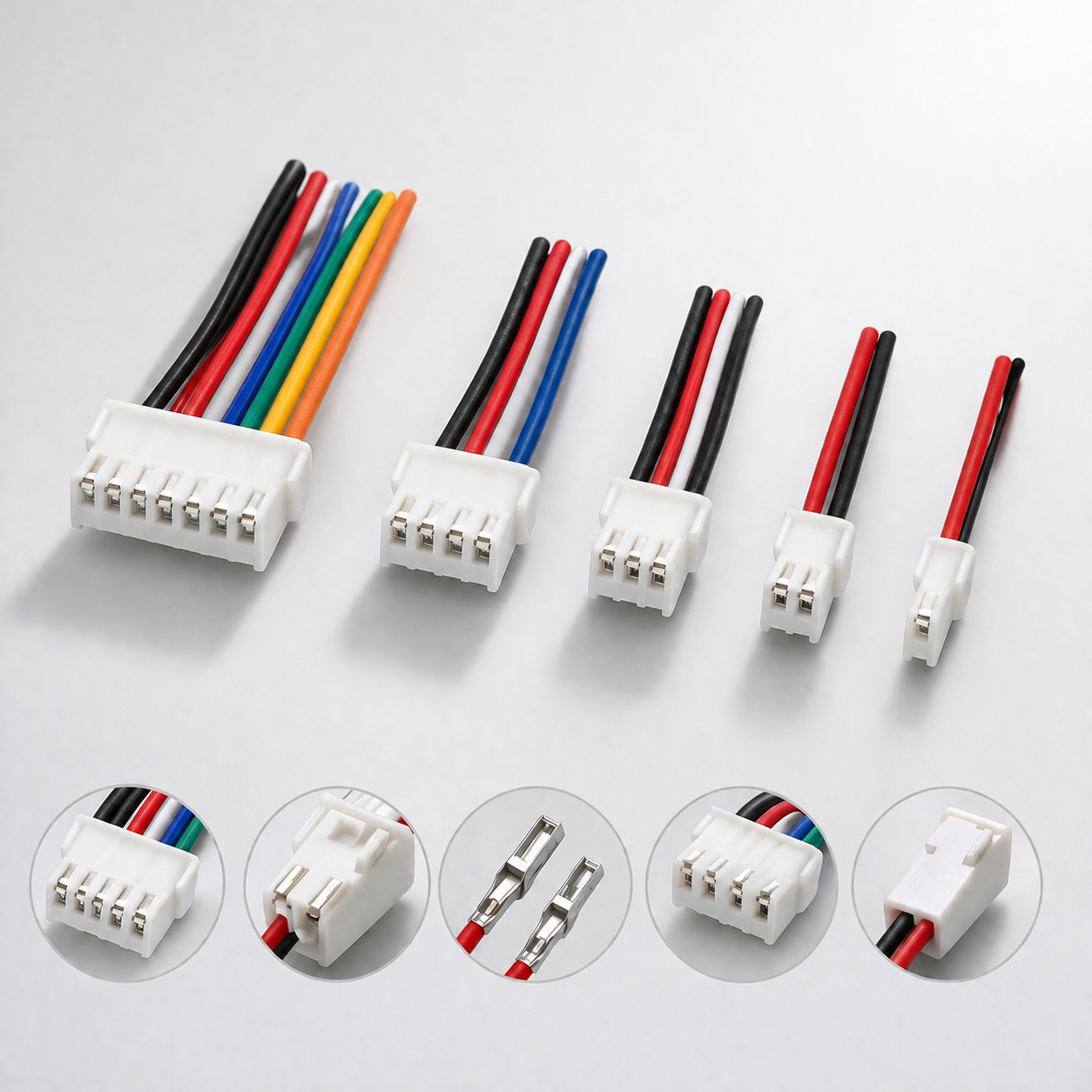
If you’ve ever built a drone, worked on an Arduino project, tinkered with an RC car, or assembled a custom PCB — there’s a very good chance a JST connector was holding it all together.
Small, reliable, and surprisingly versatile — JST connectors are one of those components that quietly show up everywhere. Yet most makers don’t know nearly enough about them.
That changes today.
What Are JST Connectors?
JST stands for Japan Solderless Terminal — the Japanese company that originally designed this connector series back in the 1950s. What started as an industrial solution has become one of the most widely used electrical connector families in the world.
A JST connector is a small, plastic-housed electrical connector used to join wires to circuit boards or to connect two wires together. They come in a range of pitch sizes, current ratings, and pin counts — making them adaptable across an enormous variety of electronics applications.
The key appeal? They’re compact, secure, and easy to disconnect when needed — without soldering.
Why JST Connectors Are Everywhere in Electronics
Walk into any electronics project and you’ll find JST connectors doing the quiet work of keeping things connected.
They lock in place. Unlike bare wire connections or simple pin headers, JST connectors have a positive locking mechanism — a small click that confirms the connection is secure. No accidental disconnections mid-project.
They’re polarized. The connector can only go in one way. That single design feature prevents reverse polarity mistakes — one of the most common ways beginners accidentally damage components.
They’re compact. In a world where PCBs are getting smaller and builds are getting tighter, JST connectors fit where other connectors simply won’t.
They handle a clean range of voltages and currents. Depending on the series, JST connectors comfortably manage the power requirements of most hobby and professional electronics applications.
The Main JST Connector Series — and What They’re Used For
Not all JST connectors are the same. The family covers several series, each with a different pitch (the distance between pin centres) and different use cases.
JST PH (2.0mm pitch)
One of the most popular series in hobby electronics. Widely used in LiPo battery connections, small robots, sensor modules, and development boards. If you’ve charged a small drone or connected a LiPo to an Arduino shield — you’ve likely used a JST PH connector.
JST XH (2.5mm pitch)
Slightly larger than PH, the XH series is common in RC electronics, balance charger connections, and multi-cell battery packs. A reliable workhorse for medium-duty connections.
JST ZH (1.5mm pitch)
Ultra-compact. Used in applications where space is at a real premium — wearable electronics, compact IoT devices, and miniature sensors. The ZH series is where JST connectors get seriously small.
JST SH (1.0mm pitch)
Even finer than ZH. Found in high-density PCB designs, compact camera modules, and precision electronics where every millimetre counts.
JST SM (2.5mm pitch)
Designed for wire-to-wire connections rather than wire-to-board. Common in LED strips, lighting assemblies, and outdoor electronics where quick disconnect capability matters.
JST VH (3.96mm pitch)
The heavy-duty end of the JST family. Used in higher current applications — motor connections, power distribution, and industrial electronics that need more than the smaller series can handle.
Common Applications of JST Connectors
JST connectors show up across a surprisingly wide range of projects and industries:
Drones and UAVs — LiPo battery connections, ESC wiring, and flight controller inputs almost universally use JST PH or XH connectors.
Arduino and Raspberry Pi Projects — Sensor connections, power inputs, and peripheral wiring on development boards frequently use JST connectors for clean, reliable, removable connections.
RC Vehicles — Battery packs, speed controllers, and receiver connections in RC cars, boats, and planes rely heavily on JST XH and VH series connectors.
3D Printers — Thermistor connections, fan wiring, and heated bed connections inside most 3D printers use JST connectors throughout.
Wearable Electronics — Compact JST ZH and SH connectors are the go-to choice for wearable tech where size and weight are critical.
IoT Devices — Sensor modules, battery backups, and peripheral connections in IoT builds benefit from JST connectors’ compact, secure design.
LED Lighting Systems — JST SM connectors are widely used in LED strip assemblies and addressable lighting setups for easy installation and maintenance.
Consumer Electronics — Laptops, smartphones, cameras — JST connectors are used internally in consumer devices more than most people realise.
How to Choose the Right JST Connector
Getting the right JST connector comes down to four things:
Pitch size — Match the pitch to your board or mating connector. Using a 2.0mm connector where a 2.5mm is needed won’t work — and forcing it risks damaging both.
Pin count — How many wires need to connect? JST connectors are available from 2 pins to 12 pins and beyond, depending on the series.
Current rating — Know how much current your application draws and choose a series rated above that. The VH series handles significantly more current than the PH series.
Wire gauge compatibility — Each JST series is designed for a specific range of wire gauges. Using wire that’s too thick or too thin affects both the crimp quality and the electrical connection.
When in doubt, check the datasheet for the specific series you’re working with. It tells you everything — pitch, current rating, voltage rating, and compatible wire gauges.
JST Connectors vs Other Connectors — Why JST Wins for Hobby Electronics
There are plenty of connector options out there — Dupont connectors, XT30, XT60, Molex, and others. So why do makers keep coming back to JST?
Size advantage. For low to medium current applications, JST connectors are significantly more compact than most alternatives.
Locking mechanism. Many connector types rely purely on friction. JST connectors click and lock — a meaningful reliability advantage in builds that vibrate, move, or get handled frequently.
Polarization. This alone makes JST connectors safer for beginners and faster for experienced makers. No guessing, no mistakes.
Availability. JST connectors are widely stocked, well-documented, and available in crimp, pre-crimped, and assembled forms — making them easy to source for any project.
Tips for Working with JST Connectors
Use the right crimping tool. A quality JST crimp tool makes a significant difference. Poor crimps lead to loose connections, intermittent failures, and frustrating troubleshooting sessions. If you’re doing more than a few connections, invest in a proper tool.
Don’t pull on the wire — pull on the housing. Disconnecting JST connectors by yanking the wire damages the crimp and weakens the connection over time. Always grip the plastic housing.
Keep a variety on hand. Projects change. Having an assortment of JST PH, XH, and SM connectors in your workspace means you’re never stuck mid-build waiting for a part.
Label your connectors on multi-wire builds. In complex wiring harnesses where multiple JST connectors of the same type exist, a small label saves significant troubleshooting time.
Check polarity before powering up. Even though JST connectors are polarized, always verify your wiring against the schematic before connecting power for the first time.
Where to Buy JST Connectors in India
Finding quality JST connectors locally can be hit or miss — and ordering from unreliable sources often means inconsistent quality, missing crimp contacts, or connectors that don’t quite match the spec they claim.
MakerBazar is one of the most reliable places to buy electronic components online in India — including a well-stocked range of JST connectors across the most commonly used series.
Whether you need JST PH connectors for a LiPo battery project, JST XH for an RC build, or JST SM for an LED strip installation — MakerBazar stocks them in the configurations makers actually need. Pre-assembled pairs, loose housings, crimp contacts, and connector assortment kits are all available.
The advantage of buying electronic components online through MakerBazar is that the components are curated for makers — not just listed and forgotten. You get accurate specifications, reliable stock, and fast delivery across India.
For anyone serious about their builds, having a trusted source for JST connectors and other electronic components matters more than most people realise — until a project stalls because a connector didn’t arrive or didn’t work.
MakerBazar removes that frustration entirely.
Final Thought
JST connectors are one of those components that seem minor until you understand how much work they’re quietly doing in every build.
Compact, polarized, lockable, and available in a range that covers almost every application — they’re one of the most practical families of electronic components a maker can stock.
Whether you’re deep into drone builds, prototyping on Arduino, wiring up a custom LED installation, or assembling your first electronics project — the right JST connector makes the connection clean, secure, and reliable.
Small component. Big difference.


Comments
Post a Comment